PRISM Live Studio: Games & IRL
- 4.3
- Rating
- 10.00M
- Installs
- Free
- Price

 Analysis by App-foxy
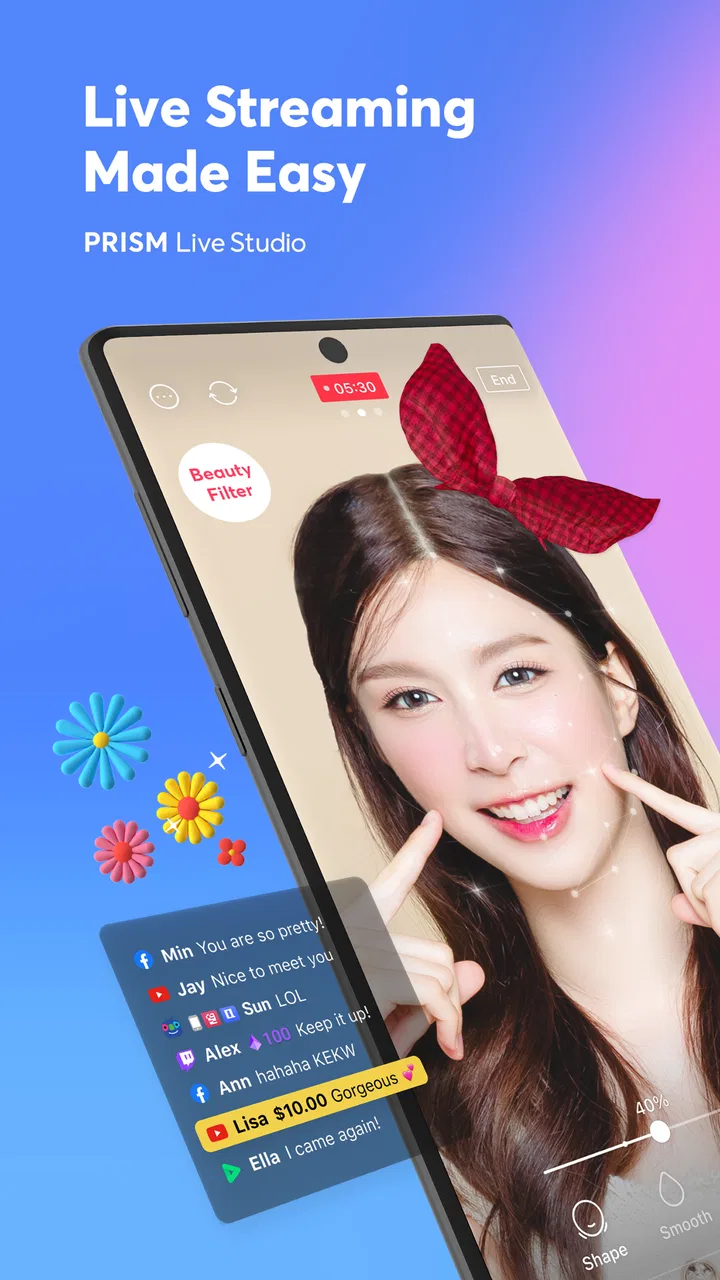
I spent time with PRISM Live Studio as a mobile broadcasting and video-editing app, paying particular attention to how comfortably it works for people with different abilities, devices, and streaming habits. It is made by NAVER Corp. and sits in the Video Players & Editors category, but that label only tells part of the story. In practice, it is aimed at people who want to go live from a phone, add a more deliberate presentation than a basic camera app allows, and send the result to services such as Facebook, YouTube, Twitch, and other supported platforms.
My first impression was that the app makes live video feel more approachable than a desktop broadcasting setup. I could think about the content rather than immediately dealing with a complicated scene-building workflow. That does not mean it is effortless for everyone. Streaming still involves account connections, camera choices, audio decisions, network conditions, and on-screen controls. The useful question is whether the app makes those steps manageable, especially when the user is working in a noisy room, holding the phone one-handed, reading small interface elements, or trying to keep attention on an audience.
It is free to download, carries a Teen content rating, and has reached more than five million installs. Its average rating is 4.5 from roughly one hundred thousand ratings, with about one and a half thousand written reviews. Those figures suggest a well-established audience, but they do not remove the need to test whether its workflow suits a particular person. The current version is 5.1.5, and it requires Android 10 or later, a detail that matters if you are using an older phone or managing devices for family members.
You May Also Like

 Blood Strike: 2.5 Anniversary
Blood Strike’s Loadouts Turn Every Drop Into a Tactical Gamble
A close look at Blood Strike’s custom loadouts: how fast access to signature weapons reshapes its battle royale rhythm, rewards preparation, and narrows the gap between fights.

 Pandora - Music & Podcasts
Pandora’s Music Is Easy to Start, but Harder to Recover
Pandora’s strength is its low-effort path from a seed to a station. Its weak spot is how much confidence it asks you to place in connection, setup, and quiet recovery.

 8 Ball Pool
 Is Built on Rivalries, Rematches, and Routine
A close look at the rivalries, rematches, shared routines, and unanswered safety questions that turn a quick pool match into a persistent mobile community.

 Samsung Music
’s Quiet Strength Is Playing What You Already Own
Its reach comes less from spectacle than from dependable access to a personal library. That simplicity is both the app’s strongest retention engine and its ceiling.

 AccuWeather: Weather Radar
AccuWeather Review: A Quick, Clear Forecast for Everyday Decisions
For everyday plans, the best forecast is the one you can understand quickly. AccuWeather makes rain timing, radar, and local conditions easy to act on, with a few trade-offs.

 Hill Climb Racing
Why Hill Climb Racing Still Turns Crashes Into One More Run
A tiny car, a bumpy hill and one more upgrade: Hill Climb Racing keeps resurfacing because its simple chaos makes every near-miss feel personal.
More From Our News Desk



How comfortably the app can be read and navigated
The main strength of the interface is that its purpose is fairly easy to understand. I did not feel that I needed to learn a full desktop production vocabulary before attempting a broadcast. The central choices revolve around what I want to stream, where I want to send it, and how I want the picture and sound to appear. That directness is valuable for beginners and for anyone who finds dense editing software tiring to navigate.
At the same time, a live-streaming screen can become visually busy because it has to expose several kinds of information at once. Camera preview, broadcast status, destination, controls, and production options compete for attention. Someone with reduced vision may find that the difference between a control that changes the presentation and one that starts the broadcast is not always comfortable to inspect quickly. I would recommend setting up a private or low-pressure test before an important event, so the user can learn where the essential controls are without rushing.
One practical habit helped me: I separated preparation from performance. Before going live, I would decide the destination, frame the camera, check the light, and think through the audio. Once the broadcast began, I tried not to keep opening menus unless necessary. This is more than a productivity trick. It reduces the number of visual decisions a person must make while also speaking, monitoring comments, or demonstrating something on camera.
The app is more approachable than many desktop alternatives because it is built around mobile use rather than a large collection of panels. That comparison has an important exception. A desktop tool usually gives more room for labels, previews, and simultaneous monitoring, which can be easier for a user who relies on a large display or needs several pieces of information visible at once. PRISM Live Studio is better when portability and a shorter path to broadcasting matter more than a spacious control room.
For readers who depend on larger text or strong visual separation, the safest approach is to adjust the phone itself before opening the app and then check whether the resulting layout remains usable. Enlarging system text can improve reading in some applications, but it may also cause controls to wrap or leave less room for the camera preview. I would not assume that a system-level change automatically makes every streaming control clearer. A short rehearsal is the right way to find out.
Planning a readable broadcast instead of improvising every control
A useful workflow is to prepare a simple visual plan. If I am showing a craft project, a game session, or a short outdoor update, I decide in advance where the important action will happen in the frame. That leaves less need to adjust the phone while live. It also helps viewers who may struggle to follow a crowded image. A stable composition is not only more polished; it reduces the amount of visual interpretation demanded from the audience.
I also found that short broadcasts are a better starting point for new users than ambitious, multi-part sessions. A brief test reveals whether the text is comfortable to read, whether the controls are reachable, and whether the user can keep track of the broadcast state. This matters for people who experience fatigue, attention limitations, or stress when several tasks happen at once. The app can make streaming more accessible, but only when the creator keeps the production plan within a manageable size.
Motor, sensory, and communication considerations
Using a phone for live video introduces a physical trade-off. The device is convenient to carry, but the user may need to hold it, reposition it, tap small controls, and speak at the same time. Someone with limited dexterity or hand tremors may find repeated adjustments uncomfortable. I would strongly favor a stable stand or another hands-free arrangement, not because the app requires special equipment, but because removing movement from the task makes the whole experience calmer and more predictable.
One non-obvious advantage of a mobile broadcasting workflow is that it can support participation outside a fixed desk. A person who cannot comfortably sit at a computer for a long session may prefer a short broadcast from a familiar room or a carefully chosen outdoor location. The benefit depends on the phone being positioned securely and the controls being prepared beforehand. Portability helps with location, but it does not automatically solve reachability or fatigue.
Audio deserves particular attention. A person may be able to see the interface clearly and still struggle with the sensory demands of live broadcasting. Background noise, wind, nearby conversations, and the phone’s position can make speech difficult for viewers to follow. Before starting, I would listen to a short recording or ask a trusted person to confirm that the voice is understandable. If the user has a quiet voice, speech difference, or limited ability to monitor sound while talking, a slower presentation and written context in the broadcast itself can help the audience keep up.
The same principle applies to visual sensitivity. Bright lighting, rapidly changing on-screen elements, or a busy background can make a broadcast tiring for both creator and viewer. A plain background, steady framing, and moderate lighting are sensible choices. I would not treat decorative production elements as automatically helpful. They can make a stream feel lively, but they also add visual load and may distract from speech or gameplay.
For creators who communicate without relying entirely on speech, the app can still be useful as a way to share a visual activity, demonstration, or presentation. However, the creator needs to plan how viewers will understand the context. A live camera pointed at an object is not self-explanatory if the important action is subtle. Spoken description, deliberate movement, and clear pauses can make the content easier to follow. This is a content-design responsibility as much as an app choice.
A realistic everyday scenario
Imagine someone who wants to show a family member how to repair a small household item while working in the kitchen. They place the phone on a stable surface, choose a platform, frame the work area, and run a short test to check whether both hands remain visible. During the broadcast, they keep the phone untouched and explain each step slowly. This arrangement avoids the hardest part of mobile streaming: trying to operate the device while performing the activity.
That scenario also exposes a limitation. If the camera needs frequent repositioning, or if the user must switch between close-up and wide views, the physical demands rise quickly. A desktop setup with a larger monitor, dedicated camera, or assistance from another person may be more suitable. PRISM Live Studio is most inclusive when the user can simplify the physical workflow rather than expecting the app to compensate for every mobility challenge.
Access in different places, routines, and social situations
The app’s strongest situational quality is its ability to travel with the creator. A phone-based broadcast can suit a student sharing a school project, a hobbyist showing a local event, or a gamer who does not want to remain at a desk. The store summary specifically positions it for live streaming across major platforms, so its value is not limited to one kind of content. I see it as particularly useful for people who need a compact setup and want to begin with equipment they already understand.
That flexibility comes with environmental risks. Outdoor lighting changes, public noise can overwhelm speech, and a weak connection can interrupt the experience. A person with hearing sensitivity may find a crowded location exhausting; a person with low vision may find changing light makes framing difficult; and someone who depends on predictable routines may prefer to prepare everything indoors. The app does not make every location equally workable. It gives the creator a mobile option, while the surroundings still determine how comfortable and reliable the session will be.
A good compromise is to use the app for a planned segment rather than an entire unpredictable day. For example, I would record or stream the important demonstration from a quiet, prepared spot, then stop instead of continuing through a noisy transition. This reduces sensory overload, conserves battery and attention, and gives the audience a clearer experience. It also makes the app more suitable for users who need regular breaks.
Platform choice can affect inclusion as well. The app supports destinations such as Facebook, YouTube, and Twitch, but the audience experience will vary depending on where viewers already participate. A creator should choose the service that their intended viewers can comfortably access and follow. The most technically convenient destination is not always the most socially accessible one.
For families, educators, and community groups, I would also think carefully about who appears on camera. A mobile stream can begin quickly, which is convenient, but that convenience can encourage rushed framing. Before broadcasting, check whether other people, private documents, or sensitive surroundings are visible. This is especially important when the creator is working in a shared home or public space. Accessibility includes giving people enough time and control to understand what will be shown.
When a mobile-first workflow is the better choice
I would choose this app over a conventional desktop broadcasting tool when the main obstacle is setup complexity or location. A phone can be placed near the activity, carried between rooms, and used without building a full production station. That makes it a sensible starting point for someone who feels intimidated by computer-based streaming or who needs to create from different places.
I would choose a desktop alternative when the broadcast requires detailed scene management, extensive monitoring, precise audio mixing, or long sessions with several sources. A larger interface may also be preferable for users who need bigger controls or who find phone screens tiring. The decision is not about which category is universally superior. It is about whether portability or workspace clarity removes the bigger barrier for the individual creator.
Where friction and barriers remain
The first barrier is the learning curve hidden behind the simple premise. Starting a broadcast may look straightforward, but a responsible creator still has to understand the selected platform, camera orientation, audio behavior, and what viewers will see. New users can easily focus on the visual presentation and overlook sound or privacy. My advice is to treat the first session as a rehearsal, even if the app makes the launch process feel quick.
The second barrier is device compatibility. The app requires Android 10 or later, so older Android phones are excluded from the supported starting point. That is not a problem for a recent device, but it can matter for users who rely on an older handset because of cost, familiarity, or a larger physical design. Before planning a regular streaming routine, check the operating-system requirement and make sure the phone can handle the intended workflow comfortably.
There is also a financial boundary despite the free entry point. In-app purchases range from about ten dollars to around eighty dollars per item. I would not assume that a free installation means every possible production option is included without additional spending. Anyone working with a strict budget should begin with the basic workflow, identify which functions are genuinely needed, and avoid purchasing extras simply because a broadcast feels unfinished.
Another limitation is the physical reality of a phone screen. Even if the app keeps the process more focused than a desktop suite, small controls and limited preview space can become tiring during long sessions. This is especially relevant for people with reduced vision, limited concentration, or conditions affected by sustained screen use. A shorter broadcast, a stable setup, and planned breaks can improve the experience, but a larger-screen workflow may still be the better answer.
Live content also creates pressure that no interface can remove. Viewers may ask questions quickly, the creator may lose track of time, and unexpected sounds or interruptions can occur. For users who find rapid social interaction difficult, it helps to define the purpose of the broadcast and prepare a few phrases or explanations in advance. If the goal is to share a demonstration rather than maintain constant conversation, say less and let the visual activity carry more of the session.
Who should use it, and who should look elsewhere
I recommend PRISM Live Studio to a beginner who wants to try mobile live streaming without immediately committing to a complex computer setup. It is also a good fit for creators who move between locations, hobbyists who want to show an activity as it happens, and gamers or presenters who value a direct route to familiar streaming platforms. Its free starting point lowers the risk of experimenting, while the established user base indicates that it is not an obscure one-off tool.
I would be more cautious if you need highly detailed production control, depend on a very large interface, use an older Android device, or plan long broadcasts that require constant monitoring. Someone who cannot comfortably tap a phone while speaking should arrange the broadcast so the device remains untouched, or consider a setup operated by another person. If your priority is advanced desktop-style control rather than mobility, a conventional computer solution may serve you better.
My inclusive verdict after using the mobile workflow
PRISM Live Studio succeeds because it brings live video closer to the way people already use their phones. I found its mobile focus less intimidating than starting with a full desktop production environment, and its support for several familiar destinations makes it practical for different audiences. The most meaningful accessibility benefit is not a single promised feature; it is the ability to build a smaller, more personal broadcasting setup around a familiar device.
That benefit has clear limits. Readability depends on the phone and the user’s settings, motor comfort depends heavily on how the device is mounted, and sensory access depends on the room, lighting, sound, and pace of the broadcast. The app can support a thoughtful workflow, but it cannot guarantee that every environment or audience will be comfortable. I would judge it by the complete arrangement, not by the app in isolation.
My best advice is to prepare the scene, test the audio, place the phone securely, and keep the first broadcast deliberately simple. Those steps help users with different abilities while also improving the experience for everyone watching. They reduce last-minute tapping, prevent avoidable distractions, and make it easier to stop when attention or energy runs low.
Overall, I see it as a strong choice for accessible-minded mobile streaming when portability and a manageable starting point matter most. It is not the right tool for every creator, particularly those who need expansive controls or older hardware support. But if you want to share a game, activity, or real-world moment from a phone and are willing to design the session around your own comfort, this app is worth trying. The best result comes when its convenience is paired with a stable setup and an honest understanding of the remaining barriers.
FAQs for PRISM Live Studio: Games & IRL
01What is PRISM Live Studio: Games & IRL?
PRISM Live Studio: Games & IRL is a versatile live streaming app designed for both gaming and real-life broadcasts. It allows users to stream high-quality video content directly from their mobile devices, offering various features like multi-streaming, real-time editing, and interactive engagement tools. It's perfect for gamers, vloggers, and influencers.
02How user-friendly is PRISM Live Studio for beginners?
PRISM Live Studio is designed with an intuitive interface that makes it accessible for beginners. The app provides easy-to-follow tutorials and a straightforward setup process, allowing new users to start streaming quickly. With customizable settings and a supportive community, even those with little experience can create professional-looking streams.
03What features does PRISM Live Studio offer for stream customization?
PRISM Live Studio offers a range of customization features, including real-time video editing, overlays, filters, and effects. Users can also add text, images, and music to their streams. The app supports multi-streaming, enabling broadcasts to multiple platforms simultaneously, and provides analytics to track viewer engagement.
04Is PRISM Live Studio free to use, or are there in-app purchases?
PRISM Live Studio is free to download and use, offering a variety of features at no cost. However, there are optional in-app purchases and premium features available for users who want to enhance their streaming capabilities with additional tools and effects. These purchases are entirely optional and not necessary for basic functionality.
05What platforms can I stream to using PRISM Live Studio?
With PRISM Live Studio, you can stream to a variety of popular platforms including YouTube, Twitch, Facebook, and more. The multi-streaming feature allows you to broadcast to multiple platforms simultaneously, maximizing your reach and engagement with your audience across different channels.
Pros
- User-friendly interface for seamless streaming.
- Wide range of filters and effects available.
- Supports multi-platform streaming easily.
- High-quality video resolution options.
- Real-time chat feature enhances interaction.
Cons
- Limited customization for advanced users.
- Occasional lag on lower-end devices.
- In-app purchases can be pricey.
- Requires stable internet for best performance.
- Some features locked behind a paywall.

PRISM Live Studio: Games & IRL
Gallery